Thursday, September 30, 2010

Lost Cities and Forgotten Ruins


Second only to the archetypal Dungeon, Lost Cities are my favorite adventuring locale (with sinful urban locales running a close third). You could do a lot worse than base a campaign around these three modules (and perhaps locate them all on a Dreaded Isle?): archaeological sword & sorcery!

Lost City and Forbidden City in particular are amazing modules. Lost City offers a near-megadungeon-sized expansion, and the Forbidden City interior cover map just begs to be ripped off for your own, customized, Eldritch Ruin.

There's plenty of good pulp inspirational reading too, from R'lyeh to Elric's R'lin K'ren A'a. Tolkein's Annuminas has always seemed in need of further exploration to me, out in its troll-infested, ranger-patrolled wasteland.

What's your favorite Lost City?

Tuesday, September 28, 2010

Omegea Atlas - Hathras, City of Dreams


Hathras, City of Dreams

Through the Western Waste, across the dead Marshes of Mayz, you arrive at the banks of the tepid River Lozsh. Stretching for a mile on either side of the river is the rambling, terraced City of Hathras. The city looks like a ruin in Springtime: jumbled marble columns draped in flowering vines, broken fountains that spill their crystalline waters out across the delicately cobbled streets, roofless palaces alive with mingled shadows , dappled sun beams, lilting songs, and faerie laughter. But this is no true ruin - the City of Dreams is rich, and well populated.

The folk of Hathras are ancient, decadent, and hedonistic, the last inheritors of a once-proud empire that has degenerated into indolence and escapism fueled by music, wine, and rare intoxicating herbs cultivated on the borders of the Marshes of Mayz. They earn their wealth through the sale of these herbs, which circulate all across the face of Omegea. The population of the city is roughly 20,000, though it is estimated 15,000 of these are slaves, mercenaries, and visiting merchants. The remaining 5000, true-blooded Hathrans, live as spoiled princes and princesses.

Aside from the competent mercenary companies, two important factors keep the city, seemingly ripe for rape and plunder, safe from harm. The first is the city's location. Bordered by the deadly marshes to the south, and by the near-impenetrable Jungles of Gil'Loorth to the north, getting any sizable force near to the city would be difficult at best, and very likely more expensive than sacking the city could repay.

The other factor is the presence of Grom, the Sleeping God, who slumbers in a drug-and-drum-induced dream-state, within a palace somewhere in the city. When last Grom woke, two centuries ago, to war against Hokhli the Wolf, the earth trembled and withered beneath his cloven feet. The folk of Hathras, goaded on by the infamous, immortal minstrel Jingolor, offered the god rest and succor. Since then, at least one Hathran Dream-Witch has remained close to the god, drumming and keeping the herb-brazier full and smoking. It is said that occasionally the bizarre dreams of the god come to life, sometimes to the terror, and often to the amusement, of the local populace.

Saturday, September 25, 2010

Wilderlands of High Fantasy - Do you have this?


If not, you should. Unlike certain other (ahem) publishers with classic old-school RPG products, Judges Guild has its stuff up for easy, cheap download (and is also relatively easy to find on ebay). This particular book here, Wilderlands of High Fantasy, I first bought in the local corner hardware store when I was in 5th grade. It was the third RPG product I ever bought, but it was the one I used the longest (and still use).

It achieves just the right balance of detail and vagueness to inspire a referee's imagination. Its easy to play around with. My first campaign with it (B/X) was very Tolkeinesque, with elf lords and rangers and orc chieftains and abandoned dwarven mines (I'm getting a little excited just thinking about it;). In the 90's, it was home to my very own personal 1E OSR during the 2E era, and home to the classic TSR 1E adventures Temple of Elemental Evil, the Slavers series, and the Giant/Drow series (the pastel versions, of course;). In the early to mid 00's it was home to 3E and the Dungeon Crawl Classics. The last few years (C&C, Microlite20, and finally Swords & Wizardry) its been home to a series of picaresque adventures Cugel, Conan, Elric, and Fafhrd would have felt very much at home in.

Its a bit like an empty canvas that helps you fill it in as you paint. Pick a hex anywhere, make a couple of rolls on the multitude of random tables JG provides, and you're good to go.

Do yourself a favor and pick this up. The main book is here, you should get at least campaign map 1 to go with it, and it doesn't hurt to add the City State and the Ready Ref sheets.

That's 30 years or so worth of gaming material for less than $10.00.

If you have it already, share a little love in the comments below.

Friday, September 24, 2010

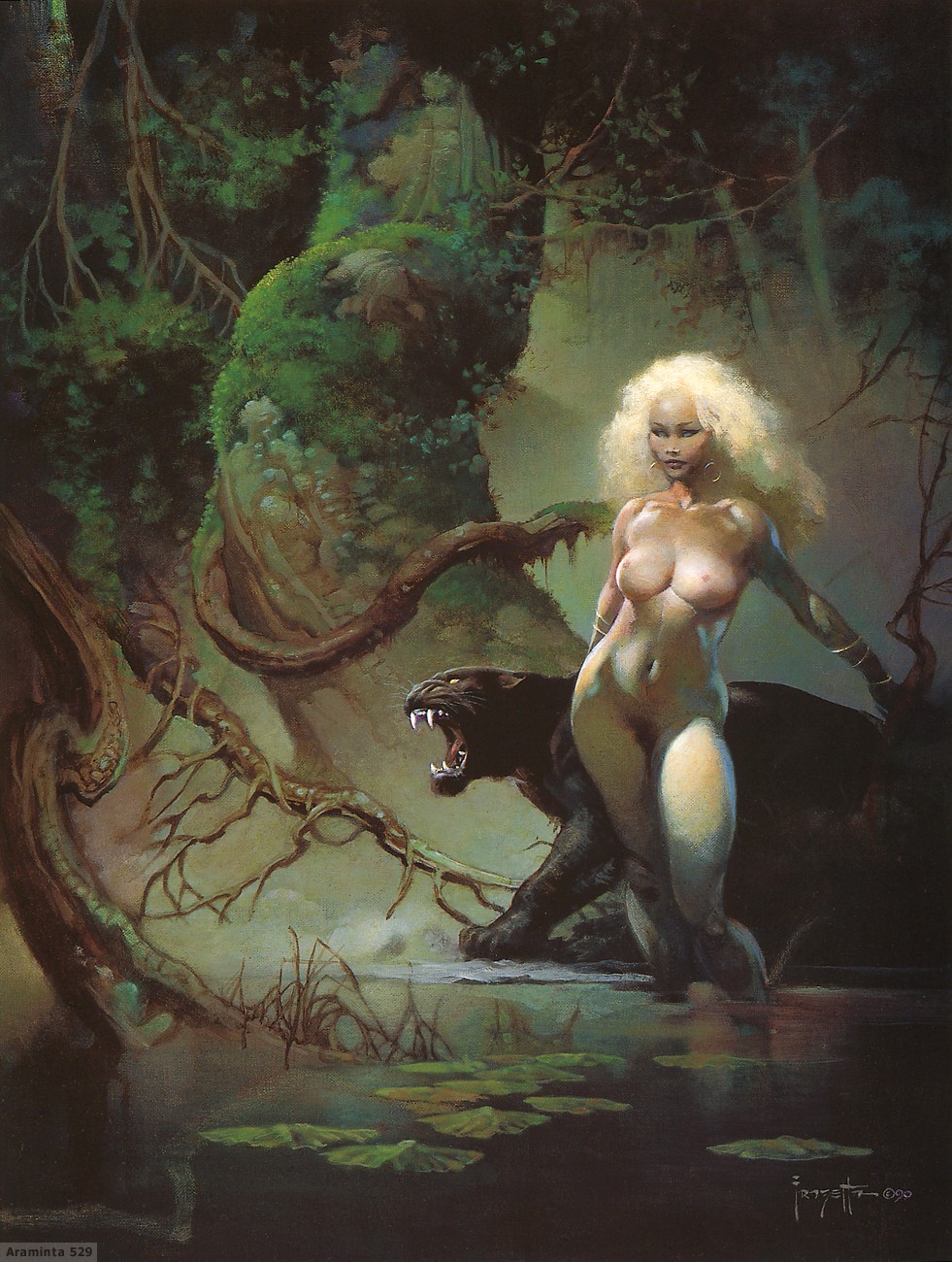
Friday Frazetta


Another favorite of mine, "Cat Girl" (click on it to make it bigger). Done in the early 80's and then, as many of Frank's paintings, retouched and revised several times over the years (and even completely redone in the 90's). Its an interesting piece, and like many classic painting through time, I believe its an allegory. The painting, to me at least, represents the three necessary elements of adventure: Temptation, in all her seductive glory; Mystery, in the form of the dark, winding forest/swamp; and Danger, in the form of the lurking cats and just the hint of a bare human ribcage lying on the ground.

Oh, and its all Green and Purple, the two most important colors in adventure, as Erol Otus would no doubt agree.

Thursday, September 23, 2010

Name that 80's show...

Ok, I'm remembering a show in the 80's about (I should say I think its about, my poor brain doesn't reach back that far with any measurable accuracy) a family that gets... transported(?) to another dimension(?) which seemed fairly earth-like but ruled by some sort of totalitarian state. The poor earth family would get hunted from town to town, I think, and I'm pretty sure there was some sort of recurring villain, a secret police type fellow in a uniform.

Anyone remember what I'm going on about, or is this a figment of my imagination?

Another. Stupid. Hammerhead.


Check Jeff's Blog today for some cool catalog images from 1979. Really takes me back - I can remember drooling over toy catalogs as a kid.

I can also remember hoping, each birthday and Christmas, that I would get droves of Imperial Stormtroopers for my Luke, Han, and Chewie figures to blast their way through. Instead, I got F'n Hammerhead. Over and over and over again. I literally had a dozen of these ugly idiots.

I'm not sure what attraction this beanpole, blue-unitard-wearing slugface had for my parents, grandparents, aunts, uncles, and cousins, but they seemed unable to avoid buying me the hideous things. I mean, this guy was in the movie for what? 1.3 seconds? Sitting there in the cantina gurgling and looking hideous. If you ever needed any confirmation (other than senor Binks) that the folks in charge of the Star Wars franchise have perhaps completely lost touch with their fanbase, you need look no further than this atrocity: A F'n Hammerhead Jedi.

If I ever get my hands on one of these figures I'm going to destroy it in the most unpleasant way I can devise.


F you, Hammerhead Jedi. F you.

Wednesday, September 22, 2010

The "Appendix N" of Episodic Play


There are five "textbooks", if you will, that I consider to be required reading for referees and players interested in Episodic Campaigns:

The Dying Earth - Jack Vance

Really the most important, in my opinion, on the list here, The Dying Earth is the "bible" of science-fantasy, episodic gaming. Consisting of three books composed of a number of picaresque tales featuring a changing cast of eclectic persons, the world is the real character. The setting takes on depth and life and continuity, as tale after tale unwinds. As each tale unwinds, the human elements may come and go, but the setting continues to become more compelling, more saturating. This is something you want to replicate in the episodic campaign - characters can drop in and out, stories and adventures may begin and end, but the players always have a constant, cohesive sense of the world they're adventuring in, making it easier to return, or maintain involvement when events take unexpected turns.

The Complete Chronicles of Conan - Robert E Howard

Besides being one of the most iconic and engrossing bodies of hardcore Swords & Sorcery literature you can read, it is also, almost by accident, an amazing example of how Episodic Play can allow you to jump around in time. Conan's fate to become king was known from the beginning - the tales of Conan's past were not told in sequential order. Again, you have a body of work told in very separate and distinct pieces that nonetheless form a cohesive whole.

Imagine running a campaign where players roll up not 1st level characters but 10th level - beginning in the endgame. From time to time, though, a session looks back in time, and the players play out the adventurers that led them to their current lofty states.

Thieves' World - Various

A great set of books, wherein the cohesive whole is made up not just of different stories and characters but written by different authors! The stories, perhaps, would have been more appropriately gathered under the heading "City of Thieves", as the action seldom leaves the mean streets and shadowed back alleys of Haven. Which is why you want this as an Episodic Play resource - there is a metric ton of inspiration here for city-based campaigns. Grab your copy of City State of the Invincible Overlord, read a couple of these stories the night before each session, and you be good to go!

Necronomicon: Best Tales of HP Lovecraft

Lovecraft manages to build not so much a campaign setting through his loosely-connected tales of Old Ones, Madness, and Mysteries Best Left Undisturbed, but a campaign feeling. You know, when you open the first page of a Lovecraft tale, that the protagonist is likely doomed. The only mystery of the tale is the exact nature of that doom: a horrific death? Subversion to some lost ritually initiated mutation? Complete loss of sanity?

This is a good guide for running an episodic play wherein the players are rolling up characters each session that are essentially doomed from the very beginning. No one expects to run the same character again next session - but perhaps they may encounter one as an NPC in the local asylum!

Lankhmar: Fritz Leiber

I include Leiber's tales by necessity - the breadth and scope of Lankhmar's universe is dazzling, and worked so subtly into the adventures of Fafhrd and the Gray Mouser you almost don't realize it until you look back on the stories later on. Without a doubt, an achievement to strive for for any referee or world-building engineer. The great variety of types of adventures here makes these tales a vital reference - sorcery, romance, war, mystery, every genre abounds here, waiting to inspire your next session.

LinkWithin

Related Posts Plugin for WordPress, Blogger...