Monday, October 12, 2009

Eco-terrorists and Flying Staves


I took a drive west down the ever-entertaining I-90 into Pennsylvania Saturday to check out the Erie Day of Gaming. It was a nice little convention, no nonsense, just folks at tables playing and learning games. I got to talk shop with Rob Conley for a while (who has a nice surprise for you Wilderlands fans forthcoming!) before rolling up a character and joining Joe and Tim for his noon game, a playtest of Tim's forthcoming C&C adventure, run with S&W liberally houseruled, almost Arduin style, with stuff from Rob's own Majestic Wilderlands.

I ended up with Jex, a Mage of the Order of Thoth (fans of the City State will no doubt be familiar with the massive temple of that order). Jex and his companions, a berserker bodyguard and a priest. We set out in search of a missing Thothian brother and became embroiled in a little village's pollution issue, ending up venturing into a mine. Spell selection is everything in old-edition D&D, and Jex... chose poorly. He entered with a full complement of mind-bending spells guranteed to let him master any mortal foe, only to face wave after wave of mindless undead!

Fortunately, Jex was, albeit unknowingly, equipped with a potent magical artifact: the Staff of Flying! Upon a roll of a natural "1", this powerful stave flies off in a randomly determined direction, to lie undisturbed in a far corner of the chamber, ignored by all until the end of combat. Through some lucky rolling, Jex got to enjoy this puissant ability about seven or eight times over the course of the adventure.

Sans both spells and staff for most of the adventure, Jex was left to improvise as he could, which enventually paid off: a well-timed foot slid out into the path of the fleeing bad guy at the climax of the adventure sent him (triiip!) sprawling onto his evil face, leaving him vulnerable to the violent attentions of the two berserkers. Town saved, staff collected, shoe inshrined for future generations to marvel at. :)

Friday, October 9, 2009

Help! Does anyone remember...?


I'm trying to track down a toy I had when I was a kid, because I think my boys would enjoy them. They came in a bag like, and were roughly the same size as, the stereotypical "plastic army men", but they were Science Fiction versions! If anyone knows the name of these maybe I can track them down on EBay or see if the manufacturer is still around. IIRC, each bag contained several of the following:

Big turtle-shell alien w/claws
Werewolf with laser rifle
"Princess Leia"-type girl w/gun
Human w/blaster pistol
R2D2-style square robot
Earth Astronaut w/vacuum cleaner looking thingy

I know there were a couple of others, but I'm sketchy on the details. The figures came in white, black, hot pink, and day-glo green.

Anyone remember these?

Update! PatrickWR was kind enough to point me at this site, with everything you need to know about these fun little guys (pic now added above). Its funny that my recall of these (listed above) was pretty accurate, but I apparently blocked out the fact that the "Leia" figure does not, in fact, have a ray-gun, but a cash register instead! And how could I forget Darth Fuscia?

Now I just have to figure out where to buy some of these, I've never seen them in dollar stores as some folks have reported :(

Thursday, October 8, 2009

Back From the Future - Speeding up 4E Combat


There seems to be a bit of cautious curiosity in the old-school blogosphere lately concerning 4E, with most of the "cautious" aspect seemingly directed towards the perceived drastic change in flavor from traditional D&D and the sometimes overbearing length of combat time.

While most old-school DMs can adjust flavor in-play at will (for any game, not just 4E), getting those combat times down to a palatable length is more of a challenge. With the rules-heavy later editions especially, houserules can become overly complex in a hurry, so my "fix" for combat length was to come up with a simple, 3-step procedure for making combat faster, but still dangerous and challenging. The most obvious root cause of long combats turned out to be the surprisingly large number of hit points 4E monsters get. Its not unusual for an orc to have 50-60 hp or even more, for instance. Despite that, 4E PCs are still doing pretty much the same amount of damage with the basic longsword hit that they've done since OD&D.

The compromising factor in this is that 4E characters have a modest selection of "powers" at their disposal which, among other effects, often double or even triple damage output. The problem is, once those powers are used up (comparable to Vancian casting), combat is reduced to what is referred to as "The Grind": PCs chipping away at that orc's remaining 30 hp's (or worse, that Otyugh's remaining 235hp!) at a rate of 5 or 10 points of damage per round.

My solution?

Brutal 4E

Step one: Reduce monster hit points by half.

Step two: Increase monster damage by +1 per 2 levels. (as in, a 6th level monster is +3 damage with all attacks.)

Step Three: All attacks are "High Crit". (Standard crits in 4E do max damage, whereas High Crit attacks due max damage plus another roll of the weapon die.)

And there you have it.

It should be noted that, unlike monsters, PCs in no way need their hit points to be halved. 4E characters are pretty soft on hit points already, albeit on a more gradual curve from low to high level. Step two and three increase monster damage, which is already pretty devastating to PCs, and most monsters have special, more dangerous, attacks they can only access when "bloodied"(at half their starting hps), which they obviously gain access to a whole lot faster when they start out with half to begin with! PC fatalities may actually increase, if they aren't careful.

With regards to those PC powers, their value increases drastically under Brutal 4E, and players will begin to manage their expenditure more wisely, rather than using them all at once just to get through the first encounter they run into.

I came up with the houserule over a year ago (and have seen evidence of other DMs trying it out) and used it with both my Wilderlands and Forsaken Halls Megadungeon sessions (both sadly languishing in Hiatus Limbo), and it increased average combats per 4 hour session from 1-3 up to 3-5. More encouragingly, from my perspective anyway, it took enough of the emphasis off combat that the PCs spent more time exploring, investigating, and interacting. That, I suspect, is a favorable result for most old-school DMs.

Wednesday, October 7, 2009

Does your gaming group look like this?

Does it? (Click on image for larger version)

Nothing makes a Tekumel Caste-Warrior ensemble complete like sunglasses!

This is from a link from Grognardia, btw.

I have to say, in 30-odd years of gaming, I've never been to a session where anyone dressed in costume as their character. This seems to be a common stereotype of gamers (a certain episode of Reno 911 comes to mind), but I thought it based solely on myth/assumption (or convention shenanigans)!

Have you ever gamed in costume, or with a group in costume?

If so, please share your story!

Tuesday, October 6, 2009

The One-Page Wilderness


Sean at Bite the Bulette has done a very nice one-page Wilderness, inspired by Will Douglas's Northmarch. I hope we see more of these from the old-school blogosphere!

I did a sort of "one-sheet" Wilderness a while back, when I was putting alot of stuff together for Microlite20; a campaign setting on one (front and back of a) sheet, called Lands of Lyrion. You can gaze upon its pulp-fantasy-inspired cheesiness here.

I think I might do a similar one-sheet for my mystery campaign mini-setting discussed here, just to see what it would look like. Sort of like Lyrion, but on a smaller scale, I'd want a tiny bit of detail on the towns and cities, some "lurid lairs", and perhaps a small pantheon of deities.

Monday, October 5, 2009

Thursday, October 1, 2009

Healing in a Low-Magic Campaign


Wanting to run a campaign based on a low-magic, Sword & Sorcery, genre can be difficult with regards to healing. Most class-based, old-school games hang healing solely on the shoulders of a "Cleric" or other priestly class. This includes not only healing generic hit-point damage during an adventure, but also stuff like poisons, diseases, etc. The result of this is that adventuring parties often feel the need to include or hire one or more Clerics as a sort of walking band-aid.

The Cleric as a class concept has its genesis in the "holy" knightly orders of the crusades. It is intended to be a warrior-priest (this is important - clerics weren't necessarily supposed to end up as "divine wizards") with a selection of protective magics. Naturally, the limited number of spell slots and fire-and-forget nature of Vancian casting means most of those "protective magics" get ignored in favor of memorizing the all-important cure spells. It wasn't long before this trend became obvious and Paladins were introduced to occupy the role the Cleric was originally intended to fill.

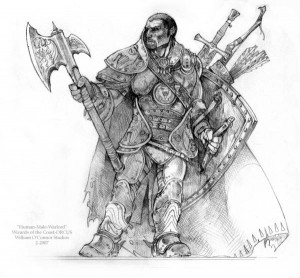
All that aside, a DM running a campaign steeped in the lore of Leiber, Howard, Vance, and so on, has little use for Clerics or Paladins from a genre standpoint. The "priests" of the genre are usually more accurately represented by the Magic-User class. But a DM wanting to omit the Cleric altogether from the campaign is basically consigning the players to short lives at worse, and short adventures at best.

Here are some options I've used with my Swords & Wizardry Wilderlands campaign, in which none of the three PCs are clerics.

Basic Healing:

After a combat, damaged PCs may spend one turn on "first aid", healing 1d4hp of damage sustained in that particular combat. This is acually an old house rule I first noticed in the old Judges Guild "Ready Ref" Sheets, and just this house rule alone improves play regardless of genre, as it also frees up Clerics to exploit a wider variety of spells. Personally, I find it also better reflects the nature of hit points themselves, in that they are a more abstract form of damage, representing not just actual wounds, but fatigue, bruising, and even combat ability. The left-over damage after the 1d4hp of first aid represents the actual injuries that will require rest or more intensive healing.

PCs regain lost hp at a rate of 1d3hp per day of rest. This is a healing rule I've adopted from the Moldvay Basic book, and far preferable in my opinion to the more common 1hp/day standard. It's faster on average, and gives the player's something to do every day (roll a d3) rather than just saying "ok, I'm down 6hp, so I rest for 6 days". Also, I consider "day of rest" to be "day spent back in town/camp". No one gets any rest down in the dungeon while nervously anticipating the next wandering Umber Hulk encounter. PCs are welcome to drink, wench, shop, and divvy treasure while "healing", provided there is a comfy bed at the Inn to retire to at a reasonable hour.

PCs regain lost hp at a rate of 2d3 per day under care of a physician. Sometimes, PCs don't have all the time in the world, or are too seriously injured, to play man-about-town. A physician does require his patient to get complete bed rest while under care, and costs roughly 1gp/hp healed. Some adventurous physicians can be lured out on expeditions at a rate of 20-50gp/day (plus cost of poultices used and the standard 1gp/hp healed as a "tip"), but will never venture into actual dungeons, rather remaining at "base camp". Such field physicians sometimes also require the aid of one or more assistants at a rate of 1gp/day.

PCs may be cured of non-magical diseases and poisons under care of a physician. Treatment typically takes 3d4 days and costs roughly 50gp/HD of the creature that inflicted the injury (for instance, disease from a giant rat costs about 25gp to cure). Again, this requires complete bedrest, and a tip of 1gp/hp cured is recommended.

Death and Negative Levels:

PCs reduced to 0 or fewer hit points die in 1d6 rounds. This represents the time the PC gets for someone to help stop the bleeding, pull out the arrow, etc, before actually dying. This is totally at the referee's discretion, of course: In cases where the damage inflicted is catastrophic, such as being reduced to -30 hp by a blast of dragon breath, the referee may rule that there is nothing left to heal! This is another discovery from those ever-helpful Ready Ref Sheets.

PCs may regain levels lost as result of supernatural level-draining effects under the care of a qualified physician. Perhaps the most radical of these houserules, its nonetheless a good idea to have something like this in place for any campaign that doesn't have a high-level cleric in every town. Regaining lost levels takes 1 week of complete bedrest for every level lost, and costs 1000gp per level lost. Treatment must begin within one month of the loss, or level loss is permanent. Only physicians with a working knowledge of the supernatural (such as witchcraft, sorcery, religious mysteries, herbalism, etc) may render such treatment.

Non-magical Healing Potions and Poultices:

Another good way to supplement the Cleric-free party is to make available some simple herbal or medicinal remedies. Some examples might include:

Poultice of Healing (50gp): This is a creamy, salve-like poultice that is applied directly to a wound. It heals 3-6(1d4+2) points of damage and prevents scarring. Such a poultice is only effective on an individual once every 24 hours. A second application is only half as effective (round fractions down), and further applications have no effect whatsoever, until 24 hours has passed.

Anti-Venom, Weak(25gp): Imbibing this fluid within one round of poisoning allows the poisoned victim an immediate second saving throw against that poison.

Anti-Venom, Strong(200gp): Imbibing this fluid within one round allows the victim an immediate saving throw at +4.

Cleansing Remedy(100gp): Imbibing this foul herbal concoction within 24 hours of contraction of a disease thoroughly and noisily flushes out the victim's system (which may be inconvenient in certain circumstances), giving them an immediate saving throw against the disease with a +2 bonus.

Veritus Charm(500gp): This holy charm, if worn openly around the neck, allows the target of level draining attacks (that wouldn't normally allow a save) a saving throw at -2 against level drain.

LinkWithin

Related Posts Plugin for WordPress, Blogger...