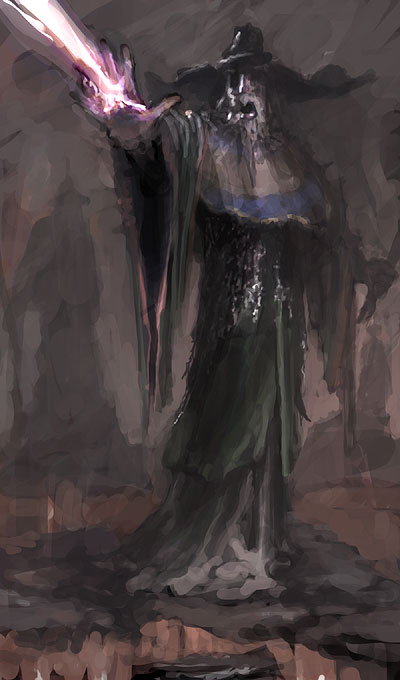
Thursday, June 17, 2010

Episodic Play - Part 3: Adventure Styles continued

From here.

Tiny Dungeons

Dungeons being the core of the game, its nonetheless difficult to use them on an episodic basis without some drastic modifications. Tiny Dungeons is one such way to fulfill your dungeon craving, and yet still be done after a normal 3 to 5 hour session.

There are two different kinds of Tiny Dungeons, literal and figurative. In the literal sense, a Tiny Dungeon is just that: a dungeon with only a few rooms, easily completed in one sessions. Sources of these are plentiful, such as the excellent One Page Dungeon Contest. With something like this handy, you can roughly estimate how long a session you're looking at, and decide from there whether you should play out travel, such as in the Relics and Ruins adventure style, or just start the session at the dungeon's front door with a quick synopsis of why the PCs are there.

If you prefer the DIY approach, my favorite model is the Five Room Dungeon. Simply put, you design a dungeon that contains a Guarded Entrance, a Puzzle, a Red Herring, a Big Finale, and a Twist. I like to add what I call a "World Building" room to this model - this is room where a plant a little info or mystery about my campaign world or its history. Something to chew on, like a statue of a forgotten god, a tablet of runes to decipher, a bas-relief depicting a scene from history - but maybe with a notable difference from the canon, etc, etc.

One of my favorite sources for Tiny Dungeons is Tony's awesome Year of the Dungeon blog. I've found these to be the perfect size for a session worth of adventure, with enough time left over for some travel and campaign plot development.

Then of course there are the Tiny Dungeons in a figurative sense. This dungeon can be as big as you want, but you're only going to play out one session's worth of adventure from it, beginning to end! One of my favorite examples of this is Moria from Lord of the Rings. This is clearly a vast underground complex, one that could take years to fully explore, but the "adventurers" really only have a few combat encounters (watcher in the lake, orcs and trolls, and balrog), a couple of puzzles (the moon-writing gate, finding the right direction), and a bit of history (the book in Balins Tomb). Take this same ethic, and apply it to something like the Temple of Elemental Evil.

To do this, what you really need is an objective. I'll cover this more in the Megadungeon adventure style section. In the case of Moria, the objective is pretty clear cut: get from one side of a mountain to the other, alive. Consider what sort of a goal or objective you could use with the Temple of Elemental Evil, pick out the most important half-dozen or so challenges you should put in the way of achieving that objective, give your players as clearly defined a route as possible, and poof!, you've turned this huge adventure into a Tiny Dungeon.


Monster Hunting

Another good episodic adventure is Monster Hunting. This adventure style can seem simple, but don't be fooled! There is more to a good monster hunt than simply rolling "troll" on a random encounter chart and siccing the players on it. Here are some good rules of thumb:

1. Select an "iconic" monster. While rooting out a nest of stirges or clearing a basement of giant rats can be entertaining once in a while, they're hardly the stuff of legend. What your players want to hunt down is something epic - a Grendel, a Smaug, a Medusa. Good monster selection is half the challenge with this adventure style. The monster should be the stuff of legend!

2. Beef up your monster. Remember, this beast is not encounter 14 of 36 - this beast is the whole adventure, so make it tough. It should be quite a few difficulty levels above what the party would normally face, and have two or even three times the hit points normal. Take a look at its attacks. If there is no possiblity of your beast wiping out the party in about three rounds, you need to beef it up. Increase numbers of attacks, damage output, effectiveness of poison, etc, as necessary. Have fun with it.

3. Prepare for more than one fight with this beast. A beast this legendary is going to be way too savvy to just stand and fight until death. A good monster hunt should have at least three fights - an initial encounter (party meets beast, and either gets whupped and runs away, or monster realizes these foes are tougher than normal and flees), an ambush (monster shows off how clever it is by ambushing the party while its recovering from the first fight), and a big showdown (typically in its lair, a terrorized village's town square, etc). Give your monster a means to heal a bit between fights, whether its regeneration, accelerated natural healing, or something supernatural (like Grendel's mom).

4. Location, location, location. Difficult terrain is best. There should be some sort of journey involved in getting to the monster's location, whether its played out or narrated (I like to keep those old black & white Tarzan movies in mind). This both removes the PCs from their resources and comfort zone, and puts them into an area where the monster has the advantage. Its also a good excuse for the party to hire lots of porters, which are fun to let the monster tear to shreds for dramatic effect. The beast's lair should also be a bitch to navigate, such as underwater, in a pitch dark cave, on a cliffside, in a maze, in a ruined temple filled with rubble, a lava-filled wastelend, and so on.

5. Give a good reason for hunting down the monster. Killing the beast shouldn't be the end, but rather the means to an end. Whether its rescuing a princess, saving a doomed village, recovering a magical artifact, capturing the beast to serve the Overlord, etc, having a reason to kill the beast has the pleasant side affect of allowing you to complicate things if the session runs short. Perhaps the princess was a similar monster, only appearing human, and now wants revenge. Maybe the Overlord doesn't feel like paying the party, and turns their captive on them at the first opportunity. Maybe the magical artifact is cursed, and turns the kindly old hedge wizard who wanted it into a raving lunatic with laser-beam eyes...well, you get the idea.

6. Encourage the party to prepare. Monster Hunts are a good opportunity to let the players flex their creative chops, so be prepared to wing a lot of rulings. These Hunts are not likely to be resolved by simple sword-swinging - there may be nets, poisons, traps, catapults and holy hand grenades involved. There may be special scrolls and potions to be recquisitioned. There may be special items and artifacts to be passed on (like that cool spear or necklace in Dragonslayer). Treat all of these things as the great opportunities for roleplay and worldbuilding they really are.

7. Not all is as it seems. It's not necessary, but rarely fails to make things more interesting. Throw the players a curve ball now and then after, or during, a Monster Hunt. Maybe that monster was put there for a reason, like to guard the Gate of Demons. Maybe the beast has been terrorizing Peace Valley because the farmers there offended Odin - guess who's on Odin's sh!tlist now? Maybe the beast is just misunderstood, or is being framed by a still darker power...

More to come...

Tuesday, June 15, 2010

Episodic Play - Part 2: Adventure Styles

Continued from here.

As mentioned last time, I've broken down the best, in my opinion, Adventure Styles for Episodic Play into five types: Relics & Ruins, Tiny Dungeons, Monster Hunting, Megadungeons, and Random Generator Travel. Speaking of Random Generators, these are your friend with Episodic Play - they can keep things just as challenging and interesting for you, the referee, as they are for the players, and help ensure you have a source for ideas even when your natural creativity is at its lowest ebb.

With that in mind, and before we get into detailed discussion about the five Adventure Styles, consider the following:

Adventure Styles Random Generation Table (d6)
1. Relics and Ruins
2. Tiny Dungeons
3. Monster Hunting
4. Megadungeon
5. Random Generator Travel
6. Referee's Choice (or roll again twice for combo-style)!

Relics and Ruins:
This first Adventure Style is my favorite and perhaps one I've used the most. While the title refers specifically to the Relics & Ruins table you'll find in three Judges Guild Products (the original Wilderlands of High Fantasy, Ready Ref Sheets, and Necromancer Games' excellent modern version of the Wilderlands), there are any number of random generation tables out there that will do the trick for you.

In the case of the Judges Guild Relics & Ruins table, a few short rolls gives you a type of relic or ruin (naturally), along with where it is (underwater, in a cave, etc), what its in (a old sack, a tomb, etc), what condition its in, and what guards it. Again, there are any number of random tables that will give you this info, the point is that you are getting something simple and to the point! There are no complicated themes (root out the traitors of the kingdom), series of objectives (collect the Seven Keys of Aurack to unlock the Gates of Bing), or great quests. Just a thing, a place, and a good reason to go get it.

Speaking of good reasons to go do something, its a good idea to provide your players with a patron - for instance, I use a few different ones in my Wilderlands games, such as Llangwellen the Blue, the Monks of Thoth, and the Roglaras Archaeological Society.

Regardless of the set of tables you use, the Relics and Ruins Adventure Style goes something like this, step by step:

1. I roll a few dice and get the following results: a totem(human), in a cave, covered in slime, guarded by an animal.
2. I decide the totem(human) is a golden statue of an old king, pick a mountainous spot on my hexmap of the Wilderlands, consult a couple of random monster charts for that animal guardian and come up with an appropriately mountain-themed one - a Yeti!
3. I decide the Roglaras Archaeological Society will be the patron to put the players on the case - following up on a shepherd's feverish claim of finding savage icemen worshipping a golden god at the top of Mount Ironclaw.

There, that should keep the players busy for 3-5 hours. Presenting them with the challenge, their first steps will likely be:

1. Finding out roughly where their goal is located.
2. Shopping! Mount Ironclaw is about a week's ride from the City State, so they'll need provisions, water, climbing equipment, warm clothing, tents, mules, and horses. I'll throw a couple of sidetracking elements into the shopping trip, like old enemies, tax collectors, pregnant ex-girlfriends, and so on, as well as a roll on my favorite urban encounters table (1E DMG).
3. Hiring! PC's will undoubtedly want to hire a guide of some sort, as well as a retainer or two to handle cooking, mule piloting duties, tent set-up, and so on. Maybe one of these guys (10%) is a spy for that despicable Temple of Harmakhis that's always up to no good.

Once properly outfitted, the players can proceed to Mount Ironclaw.

1. I take a look at the map beforehand, see that they'll pass through two villages, past one swamp and one forest, and then climb into the mountains, and try to come up with some interesting stuff to describe to them as they travel ("the edge of the causeway slopes down sharply on your right, disappearing into the murk and fog of the marsh. A wall of midges blankets the marsh's edge and something bellows from deep within the place...")
2. Three wandering encounter checks a day (I typically go with a 1in6 or 1in10 chance) - one in the morning, one in the evening, and one overnight. Don't go overboard; you want the players to reach their objective, not spend the entire session fighting item 32 on your Grassy Plains table over and over again. 1 to 3 encounters total is nice. If the players are lucky and make it almost the whole way with no trouble, throw in one automatic encounter for good measure - these guys are adventurers, not Rick Steves, after all.
3. Carefully track the use and consumption of resources. Players never plan on bringing enough water for some reason, a fact I exploit mercilessly to give players something to do while I plot the meatier parts of the adventure.

At last the party arrives at Mount Ironclaw, finds the mysterious cave, and must vanquish the guardians:

1. Try to make sure these guardians are a level or three higher than what you would normally throw at the party. There aren't going to be thirty rooms filled with orcs on this adventure - the players are free to use spells and consumable resources at a pace they'd never consider in longer adventures. You also won't have as many chances to try and kill them, and they need to feel this is appropriately dangerous. It may take two or three attempts (and hasty retreats), along with some hefty planning and strategizing to overcome the guardians.
2. There's always a catch - in this case, remember that slime covering the gold statue? I decide that's going to be Green Slime. Or maybe Chief Yeti wasn't really dead, and comes back for more.
3. If the party does succeed in winning the prize, there may be some new logistics to consider - that statue is heavy!

At this stage, consider how far along you are with the session, and how much time is remaining. If you've only got 10-15 minutes left, now is a good time to handwave any further details, give the players a congratulatory summary of what transpires next ("the Archaeological Society is overjoyed at the sight of the statue, and rewards you with a sum twice of what it is worth if melted down to raw coinage!") and hand out xp's. If substantial real time is still remaining, then its time to play out the return to the City State, which can be complicated with:

1. More random encounters! Back to those 3 checks a day, and make sure there is at least one!
2. Remember that possible Harmakhan spy? Now would be a good time for him to strike, while the party is low on hit points and resources.
3. The return to the City State may be fraught with greedy tax collectors, opportunistic thieves, cultists who worship the long-dead king the statue depicts, and so on.

At some point, the session must come to a conclusion. I like to have the PCs back in their tavern, that tankard of ale back in their hand and that wench back on their knee, their debts paid, and armor repaired, and them present them with a mystery to ponder. In this case, why were the scholars of the Archaeological Society so excited about that old king anyway? They may decide to pursue further research, and steer the campaign in a new direction, in anticipation of next week's (or next month's) episode.

More to come...

Episodic Play - Part 1


Not having a weekly group since 2008 or so, I quickly learned the value of Episodic Play, that is to say: each session is self-contained, with a beginning and an end. Obvious difficulties arose when playing long adventures or epic plotlines when the group would sometimes not play for weeks at a time - details were forgotten, immersion was nearly impossible, interest levels waned, precious table time was lost recapping the last session, etc, etc. Bringing each session into the scope of episodic play went a long way toward keeping the interest level high, imparting a feeling of accomplishment, and making it easier for players to jump in and out of the campaign.

For anyone with an interest in Pulp Sword & Sorcery literature, this style of play can hold a strong appeal - even without the need to keep an inconsistent play schedule entertaining. Pulp Sword & Sorcery, be it Conan, Fafhard & the Gray Mouser, Elric, the Dying Earth, and so on, was most often presented in the form of short stories linked to together. Also known as "picaresque" (which JM at Grognardia discusses in a great post here), the heroes of these adventures are often sitting in a tavern with a tankard in their hand and a wench on their knee when adventure comes knocking, be it welcome or not. Cliffhangers, contrived at the best of times, are happily unnecessary!

The three most important elements of Episodic Play I've noticed are Adventure Style, Session Structure, and House Rules, each of which I'll try and cover.

There are five pretty distinct Adventuring Styles I've found work well with episodic play: Relics and Ruins, Tiny Dungeons, Monster Hunting, Megadungeons, and Random Generator Travel.

More to come...

Friday, June 11, 2010

Monsterless Manual - Get yours free!

Free for download here!

The Monsterless Manual gives you short stats for more than 200 humans, from Academic to Wench, for use with your old-school fantasy rpg. Also includes an exhaustive random personality generator. Be sure to print out "little booklet" style for maximum utility and old-school effect.

Let me know what you think!

Wednesday, June 9, 2010

Judith and Holofernes


As I was reminded by my Met Museum desk calender today, this is a strangely popular subject for painting. Interesting to think that many of the painters had probably actually seen a beheading or two, thus the gruesome detail in many of the paintings. Look at that gristle! Not sure how many were actually performed by a hot redhead though;) There are literally hundreds of years worth of these paintings, from the chaste versions of the early Renaissance, to bolder and more sexual versions in the 20th century.

From Wikipedia: ...Judith, a beautiful widow and chosen by God, uses her charms to enter the tent of Holofernes, an Assyrian general out to destroy Judith's hometown. Overcome with drink, he passes out and is decapitated by Judith; his head is taken away in a basket...Judith was a character whose sexualized femininity interestingly and sometimes contradictorily combined with her masculine aggression.

Tuesday, June 8, 2010

CNN on D&D


From here.

Some interesting reporting on what WotC is doing to get players to the table.

Tuesday, June 1, 2010

The Horrible Blue Book of Jir Harish the Mad


Jir Harish, once the famed court wizard of Peldivarn, was last seen taking ship for the trackless sands of the Satripin deserts. Though he was never seen or heard from again, a number of his personal effects turned up in the markets of Mythrior, including the Blue Book. The Book details the Seven Pacts of Bhaharash-Ba, an elder elemental lord of Air.

Each Pact made imbues a wizard with a spell-like ability that may be used up to three times per day. The wizard making a pact must have undertaken any pacts below it (ie must have taken Pacts One and Two to make the Third) and must meed a minimum level requirement. Once the pact is taken, the wizard suffers a loss of sanity, the amount of which is detailed below. Thus far, no one has achieved more than four of the seven pacts without succumbing to total madness (Wis3 or lower).

First Pact - The Protecting Arms of Aballish. This pact allows the wizard to use shield up to three times per day (minimum level 3rd, Wisdom loss 1d2 points).

Second Pact - The Shifting Mirage of Kolek. This pact allows the wizard to use invisibility up to three times per day (minimum level 5th, Wisdom loss 1d3 points).

Third Pact - The Rising Winds of Lord Sande. This pact allows the wizard to use fly up to three times per day (minimum level 7th, Wisdom loss 1d3 points).

Fourth Pact - The Chilling Breath of Oltapeshi. This pact allows the wizard to use ice storm up to three times per day (minimum level 9th, Wisdom loss 2d2 points).

Fifth Pact - The Horrible Servants of Iyishi Phyyri. This pact allows the wizard to use conjure elemental (air) up to three times per day (minimum level 11th, Wisdom loss 2d2 points).

Sixth Pact - The Mighty Blessing of Baharash-Ba. This pact allows the wizard to use control weather up to three times per day (minimum level 14th, Wisdom loss 2d3 points).

Seventh Pact - The Baleful Curse of Bohorum. This pact allows the wizard to us power word, kill up to three times per day (minimum level 18th, Wisdom loss 2d4 points).

LinkWithin

Related Posts Plugin for WordPress, Blogger...